The Big Three Lifts: Squat, Bench Press, and Deadlift for Strength and Muscle
When it comes to building strength, adding muscle, and measuring progress in the gym, few exercises are as recognizable as the squat, bench press, and deadlift. Together, these movements are often called the Big Three.
They are staples of powerlifting, but you do not need to be a powerlifter to benefit from them. At Kaeos Fitness in Englewood, New Jersey, we use these movements and their variations with clients of different ages, experience levels, and fitness goals.
The goal is not simply to lift as much weight as possible. The goal is to become stronger, move better, build muscle, and develop confidence in the gym.
What Are the Big Three Lifts?
The Big Three consist of the squat, bench press, and deadlift.
Each movement trains multiple muscle groups at the same time, which is one reason they are considered compound exercises.
Unlike an exercise that focuses primarily on one individual muscle, compound movements require different parts of your body to work together. This makes them extremely useful for developing overall strength and muscle.
The Big Three also give you something that is easy to track.
If you were squatting 100 pounds several months ago and can now squat 130 pounds with good technique, you have clear evidence that you are getting stronger.
The same idea applies to your bench press and deadlift.
The Squat
The squat is one of the most important lower body strength exercises.
A properly performed squat primarily challenges the quadriceps, glutes, hamstrings, and core while also requiring stability throughout the rest of the body.
Squatting can help improve lower body strength for activities both inside and outside of the gym. Standing up from a chair, climbing stairs, playing sports, carrying objects, and maintaining independence as you age all require lower body strength.
One of the biggest misconceptions about squatting is that everyone needs to perform the exact same type of squat.
They do not.
Depending on someone’s mobility, experience, injury history, and goals, a trainer may use goblet squats, box squats, belt squats, machine variations, or traditional barbell squats.
The exercise should fit the person rather than forcing the person to fit the exercise.
The Bench Press
The bench press is one of the best known exercises for developing upper body strength.
It primarily trains the chest, shoulders, and triceps while also requiring control and stability throughout the upper body.
For someone interested in building muscle, the bench press allows several major upper body muscle groups to be challenged simultaneously.
It is also extremely easy to track.
Over time, clients can monitor how much weight they are lifting, how many repetitions they can perform, and how their technique improves.
But progress does not always mean adding another plate to the bar.
Performing more repetitions with the same weight, improving your range of motion, controlling the weight better, or using better technique can all represent progress.
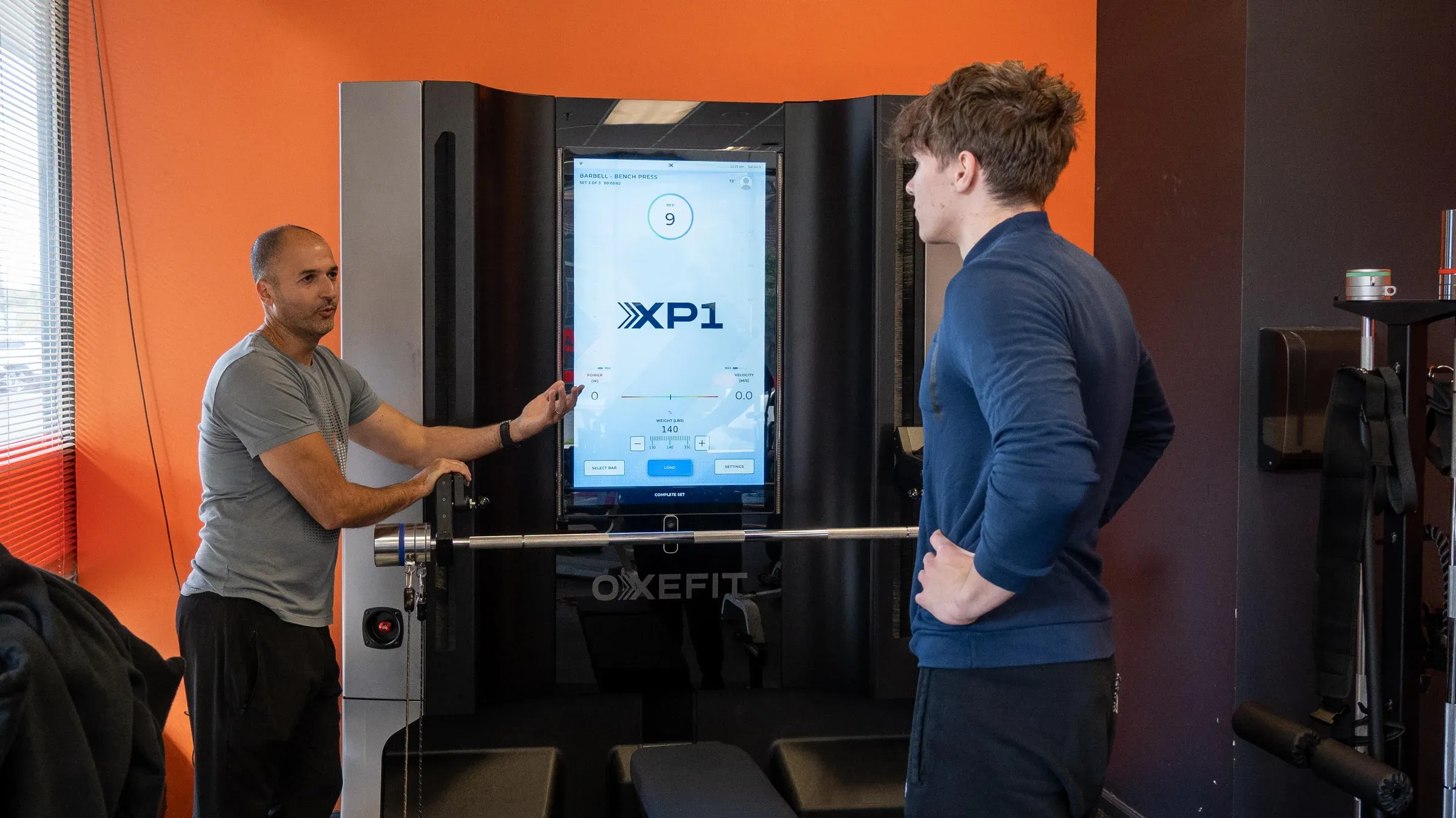
At Kaeos Fitness, we also use different bench press variations depending on the client. This can include dumbbell presses, incline presses, machine presses, and advanced resistance options using technology such as OxeFit.
The Deadlift
The deadlift is one of the most effective exercises for developing total body strength.
It strongly challenges the glutes, hamstrings, back, core, grip, and other muscles throughout the body.
At its simplest, a deadlift teaches you how to safely and efficiently pick something up from the ground.
That movement pattern has obvious benefits outside of the gym.
Learning how to properly hinge at the hips, brace the core, and produce force through the lower body can improve both strength and movement quality.
Like the squat, there are many ways to deadlift.
Some clients may use a traditional barbell deadlift, while others may perform Romanian deadlifts, trap bar deadlifts, elevated deadlifts, kettlebell deadlifts, or cable based variations.
Beginners do not need to immediately start pulling heavy weight from the floor.
Technique comes first.
Why the Big Three Are So Effective for Building Muscle
Muscle growth requires your muscles to experience enough resistance and gradually adapt to greater demands.
The squat, bench press, and deadlift allow you to train large amounts of muscle at the same time and progressively increase the challenge over time.
For example, someone may begin squatting with a light dumbbell.
As they become stronger, they may gradually increase the weight, perform additional repetitions, improve their range of motion, or progress to a more challenging variation.
This process is known as progressive overload.
Your body needs a reason to adapt.
Consistently challenging your muscles while recovering properly gives your body that reason.
The Big Three make this process easier to measure because strength improvements are very clear.
You Do Not Need to Lift Huge Numbers
One of the biggest mistakes beginners make is comparing their strength to other people.
Someone else may bench press 300 pounds, squat 400 pounds, or deadlift 500 pounds.
Those numbers have very little to do with your own fitness journey.
The number that matters most is where you started.
If your squat improves from 50 pounds to 80 pounds, that is progress.
If you could barely perform a push up when you started and several months later you are confidently bench pressing, that is progress.
If you learn how to deadlift safely and steadily increase your strength, that is progress.
Strength training should be about becoming a stronger version of yourself rather than trying to compete with everyone else in the gym.
Technique Comes Before Weight
There is nothing wrong with wanting to lift heavier.
Getting stronger is one of the main goals of strength training.
The problem occurs when adding weight becomes more important than performing the movement properly.
Beginners should focus on learning proper positioning, controlling the weight, developing consistency, and understanding how each exercise should feel before worrying about maximum strength.
A qualified personal trainer can also identify when a movement needs to be modified.
Not everyone should squat, bench press, or deadlift in exactly the same way.
Your training should account for your experience level, mobility, strength, age, previous injuries, and individual goals.
The Big Three Are Not Just for Young Athletes
Strength training can benefit people at many different stages of life.
The exercises themselves simply need to be appropriately programmed.
A beginner in their 20s, an adult trying to build muscle in their 40s, and someone in their 60s trying to maintain strength should not necessarily follow the exact same program.
However, all three may benefit from learning squat, press, and hip hinge movement patterns.
The amount of weight, exercise variation, volume, intensity, and training frequency can all be adjusted.
At Kaeos Fitness, personalization is a major part of how we approach strength training.
How Often Should You Squat, Bench Press, and Deadlift?
There is no single answer that works for everyone.
Training frequency depends on your goals, schedule, experience, recovery, and total workout program.
Some people may practice one or more of these movements multiple times per week.
Others may use each movement once per week along with additional exercises.
More is not automatically better.
A well-designed strength training program balances challenging workouts with enough recovery to allow your body to adapt.
Consistency over months is far more important than trying to do everything in a single workout.
Strength Gives You Something You Can Measure
One of the most rewarding parts of strength training is that progress is measurable.
You can track the weight you lift.
You can track repetitions.
You can track technique.
You can track range of motion.
You can track how exercises feel.
You can compare where you are today with where you were several months ago.
That feedback can be extremely motivating.
The scale may not change every week, and physical changes in the mirror can sometimes be difficult to notice from day to day.
But adding another five or ten pounds to a lift provides clear evidence that your body is adapting.
Learn the Big Three at Kaeos Fitness in Englewood, NJ
You do not need to be an experienced lifter to start strength training.
In fact, learning these movements correctly from the beginning can make a major difference in your long-term progress.
At Kaeos Fitness in Englewood, New Jersey, our personal trainers work with beginners, adults, seniors, athletes, and experienced gym members to create strength programs based on the individual.
Whether your goal is building muscle, getting stronger, improving athletic performance, losing weight, or simply becoming more confident in the gym, squat, bench press, and deadlift variations can become valuable tools in your program.
The goal is not to chase someone else’s numbers.
The goal is to keep improving your own.
If you are ready to start strength training, schedule a complimentary first session at Kaeos Fitness in Englewood and let us help you build a program that fits your goals.
Train with the coaches who wrote this
Your first personal training session at Kaeos in Englewood is free.